
AKIPRESS.COM - Alliance between government and private sector is a current trend, which develops increasingly in highly-developed countries, as well as in developing countries and countries with transition economy. For Kyrgyzstan with its weak infrastructure, low economic growth, public-private partnership’s (PPP) role can be considered as a generator of investment stream. However, at the moment real projects on PPP mechanisms are absent. As a consequence, necessity on research of barriers for formation and development of PPP in the country has arisen. This issue was examined upon the initiative of the National Institute for Strategic Studies (NISS).
Barriers on the path of development for public-private partnership in Kyrgyzstan
By Jamilya Irsakova, research assistant
PPP as generator of investment stream
Population of Kyrgyzstan is not ready to pay for infrastructure development. National budget is only one funding source and is unable to provide the functioning of this sector as required without assistance. Alliance between government and business can become a key to solve social problems of the country with its weak infrastructure and low economic growth.
Foreign experience
Similar studies were done by experts in neighboring countries. Thus, research work “How to Provide Success for PPP in Russia: Review for 2012” by Ernst & Young indicates that main obstacles blocking wider implementation of PPP in Russia are the following: federal legislation does not meet modern requirements; poor quality of PPP projects’ preparation; inadequate readiness of state authorities to implement PPP projects in practice. According to results of public opinion poll made by Kazakhstan Public-Private Partnership Center, PPP is able to be more attractive for Kazakhstan’s businesses through attractiveness of PPP projects.
Sectors
Within the framework of this research work, parties interested in PPP processes were interviewed. Respondents characterized PPP as a mechanism for attracting private sector to finance infrastructural projects under the conditions of budget deficit.
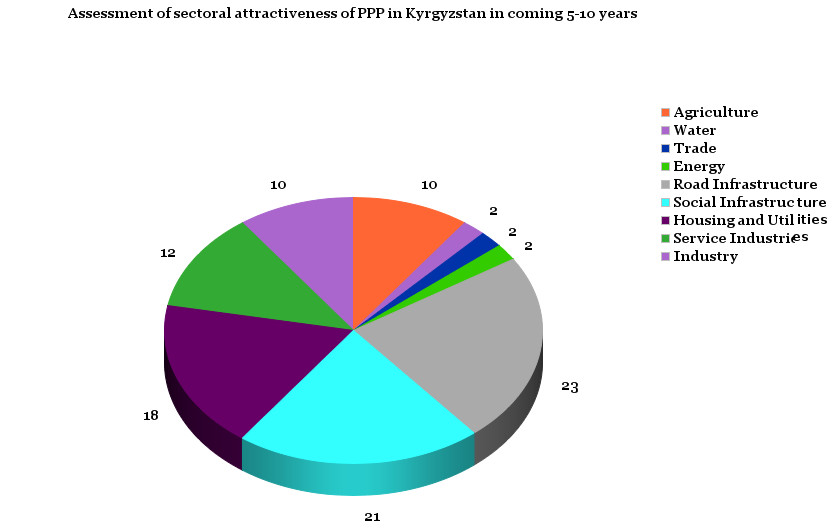
23% of respondents consider road infrastructure, 21% – social infrastructure, 18% – housing and communal services, 12% – service industries, 10% – agriculture, 10% – industry, 2% – water, trade and energy sectors as most attractive sectors for implementation of PPP in Kyrgyzstan in the coming 5-10 years. Interviewees consider that government solves social problems by means of PPP, so it has to pick out priority sectors pursuant to state needs and abilities in granting of guarantees.
President of the Suppliers Association Gulnara Uskenbayeva asserts that all sectors are ready for PPP if all projects are small-sized.
Regulatory legal acts
State authorities examine introducing amendments into regulatory legal acts as one of actuating tools of PPP in the country. Representatives of private sector say, on the contrary, that regulations are of minor importance.
Law on Public-Private Partnership
According to experts of legal company Kalikova & Associates, presence of law on PPP is a insufficient base for launching of PPP mechanisms in the country. Law is secondary, while projects should be implemented first, “after that we can come out as legal consultants for these projects”, says Gulnara Kalikova, senior partner of the company.
Specialized authorities
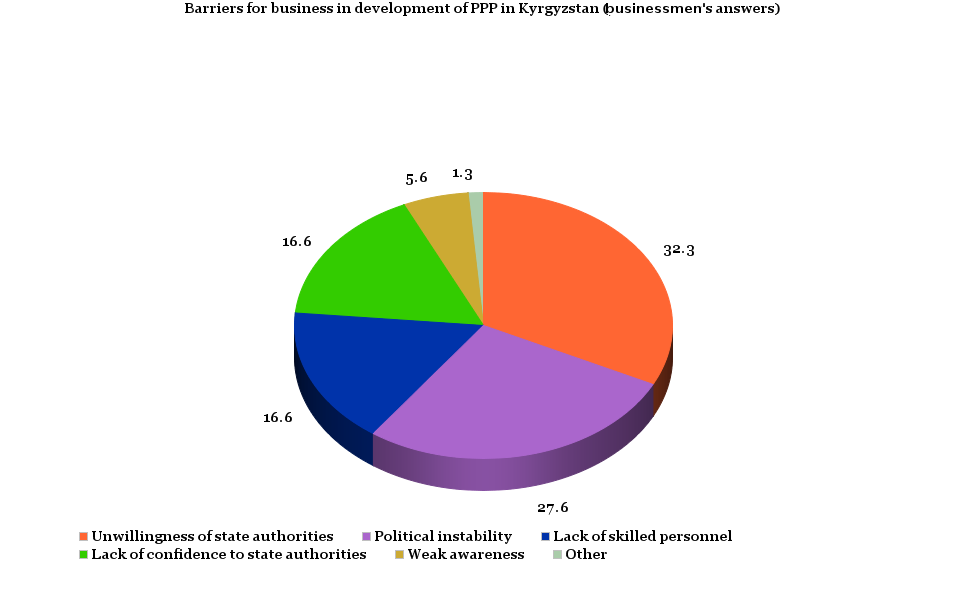
Business representatives and state authorities concur that playing the key role in development of PPP in Kyrgyzstan is assigned to the Government and the Ministry of Economy. Businessmen consider that state authorities should make first step towards launching PPP, they have to coordinate their activities and show readiness. At the same time, all respondents (including state authorities) have noted that there is absence of skilled personnel at all stages.
Potential of regions
On the one hand, respondents note risk of not covering the expenses of PPP projects in regions, uninformed population, while on the other hand, they assert regions have potential, considering large amount of small infrastructural projects.
Private sector’s potential
Local businessmen assert that they are able to invest for PPP projects under conditions that projects will have small costs.
The following problems have been identified:
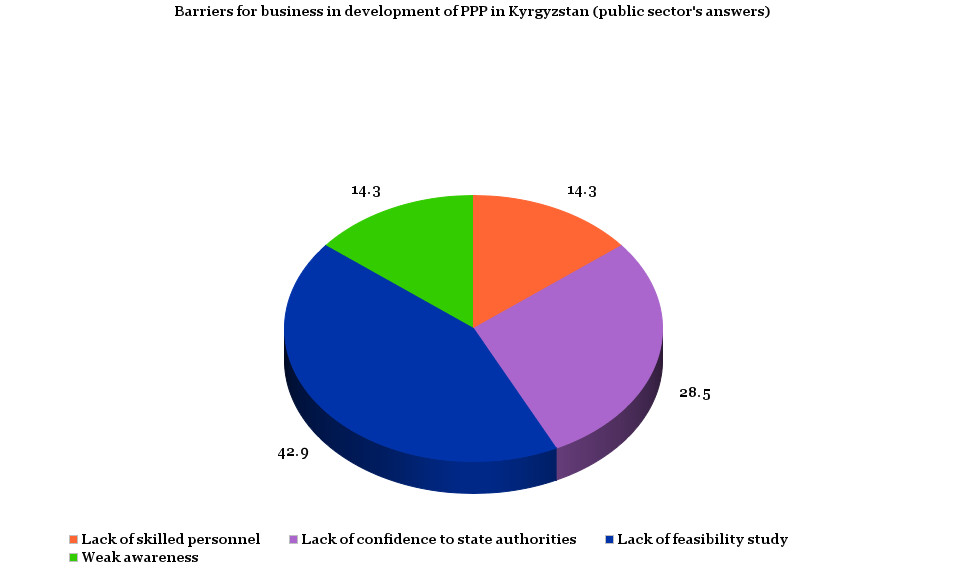
- confrontation of interests of government and private sector, non-coordination of their activities. Government considers PPP as a tool for infrastructure modernization and aims launching large-scale capital-intensive state matter projects, but implementation of these projects is impossible on government’s own.
- insignificant share of Kyrgyz businesses that are able to invest for PPP projects recommended by the Ministry of Economy. Consequently, according to PPP policy in Kyrgyzstan, foreign investor is more preferred as private partner.
- inability of population. Since government doesn’t have enough funds, one of the methods of gaining profit for private sector will be population’s payments (toll roads, fee-based education, paid diagnosing in laboratories, etc.). It is unknown, how population of Kyrgyzstan will welcome such payment practice. This factor is also in the risks list for private partner.
- weak awareness. Some private businessmen believe that any collaboration of business and government is PPP. Specialized authorities on PPP lean on international experience and consultants’ advices. Population on the whole is out of touch with PPP, so it can entail definite threats at launching of pilot project.
Recommendations
In order to overcome existing barriers, it is required to take the following measures:
- develop comprehensive measures on building bridges between potential partners. As there is a lack of dialog between parties on PPP development issues (state authorities don’t know about business’s initiatives, while businesses take a position of observer), it is required to develop measures on building bridges between potential partners. Creation of common ground for discussing of PPP development problems on continuing basis with participation of state authorities, private sector, population, loan institutions can serve as a first stage within development of comprehensive measures. This collaboration may lead to coordination on key areas.
- creation of development fund for PPP involving financial support of donors. Searching of funds for launching PPP mechanisms in the country is a primary task, while fulfilling of other tasks depends on it. Taking into consideration state budget deficit, it becomes necessary to create a fund for PPP development. It is recommended to carry out the feasibility study at the expense of the fund at the initial stage.
- launch of pilot projects. It is required to take preparation measures for launching of pilot projects. Firstly, to arrange massive information campaign on informing of PPP operation principles by a working group under the Ministry of Economy. In other foreign countries, PPP is considered as wide spectra of partners’ interaction, where managers’ experience and know-how secrets can be used as resources of private sector. Kyrgyzstan can use various PPP models well, but pilot project should serve as initial reference point, and it will not cost too expensive. Benefits for private partners must be highlighted because taking into consideration the existing conditions, it will be hard to attract businessmen for partnership. That is why state guarantees and risk distribution are very important.
- drawing up a list of infrastructural objects. It is recommended to draw up a list of infrastructural objects, which are on the books of government and could take a part in PPP projects.
- making more in-depth analytical studies on assessment of the country’s readiness to PPP mechanisms. Concrete decisions on developing of the PPP mechanisms are in need of preliminary expert-scientific, analytical studies. Russia and Belarus are more focused on market studies and situation analysis in PPP issues. On the first stages, it is recommended to make more in-depth analytical studies on assessment of the country’s readiness to PPP mechanisms on different levels.
- arrangement of education and internships in foreign countries. Due to lack of local faculty and curricula specialized on PPP, and the Academy of State Management under the President today is only one which educates on PPP, it is required to accept practice of education and internships in foreign countries, particularly through cooperation with specialized institutes and associations. For instance, Kazakhstan’s PPP Center and Russian Center for PPP Development are working with British PPP ExpertsLtd Company in employees’ education and professional development areas.