
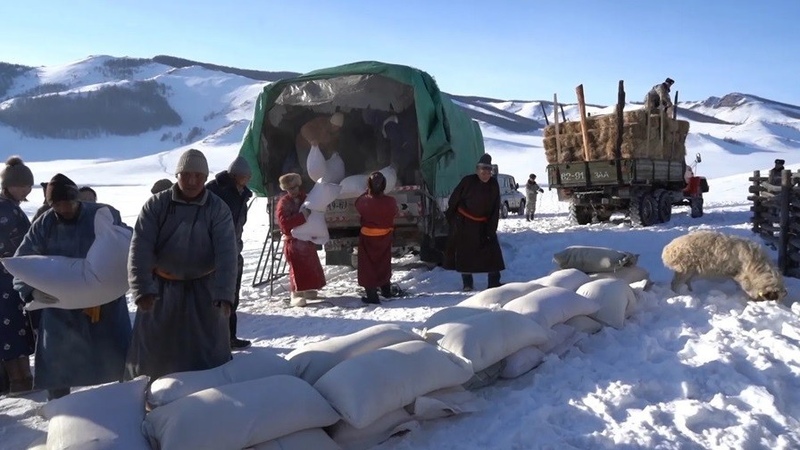
AKIPRESS.COM - Mongolia is experiencing an extremely harsh winter starting in early winter. 81% of Mongolia's territory is covered with snow, and winter and spring of 2023-2024 are forecasted to be challenging due to increasing cold, heavy snowfall, and snowstorms. Mongolia has not experienced such a severe dzud in the past 20 years, notes Deputy Prime Minister and Head of the State Emergency Commission (SEC) S. Amarsaikhan.
The current situation and measures taken on the outwintering of cattle were discussed at the session of the Standing Committee on Environment, Food, and Agriculture of the Parliament on December 19, Montsame reports.
Deputy Prime Minister and Head of the State Emergency Commission S. Amarsaikhan visited 11 districts of Arkhangai and Zavkhan provinces to oversee winter conditions and the measures.
The Head of the SEC briefed that according to the Mongolian National Agency for Meteorology and Environmental Monitoring, 70% of the total territory is at high risk of dzud, including Uvs, Sukhbaatar, Khentii, Dornogobi, and 26% at moderate risk. Deputy Prime Minister S. Amarsaikhan stressed that the issue of dzud is not only a problem of herders but also a concern of the agricultural sector, the main sector of the economy and food supply.
According to Deputy Prime Minister S. Amarsaikhan, financial sources are being solved to increase local fuel supplies, meat prepared by herders is put into market circulation, supply of animal fodder is increased, readiness of health and other public services during emergencies is ensured, acute infectious diseases among animals are being prevented, and access to quality veterinary services is ensured.
In addition, the Head of the SEC S. Amarsaikhan proposed to make amendments to the existing Austerity Law. The law prohibits to manage local budgets to solve local problems. He pointed out that the Austerity Law, adopted to mitigate the consequences of the pandemic had an effect, but in the current condition, it exacerbates the risks.
The SEC is taking appropriate measures to manage the supply of necessary fuel to rural and remote areas. By now, 60 tons of fuel requested by the Emergency Commission in Tuv, Arkhangai, and Zavkhan provinces have been supplied.
The head of the SEC pointed out the necessity of reducing or exempting tax on animal fodder, flour, and fuel imported through the Arts-Suuri border port in Zavkhan province and through the ports in the western provinces of Mongolia as a shortage of these goods and others due to transport from Ulaanbaatar city and high transport cost are causing problems.
SEC requested the Mongolian Customs General Administration be tasked to resolve border and customs issues and relevant Ministries to take necessary actions to change the situation.